
Automated Pallet Dispensers Cut Labor Costs and Improve Ergonomics
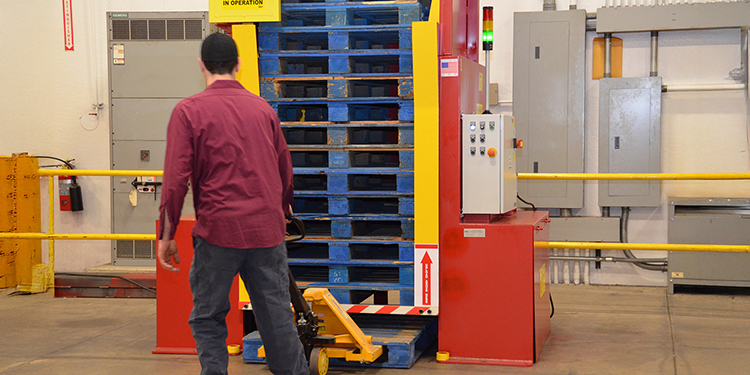
As they build pallet loads for internal storage or outbound shipment, most operations still rely on outdated pallet-retrieval methods instead of automated pallet dispensers. These legacy approaches include manual handling, where employees pull pallets off stacks by hand, and forklift retrieval, where drivers peel stacks down one pallet at a time. Used for decades, these methods seem straightforward, leading many facilities to consider them “good enough.”
Yet the reality is far different. Manual pallet handling drives up labor hours, congests docks, slows order picking, and exposes workers to injuries. All of these factors carry significant financial consequences. Indeed, operations frequently underestimate how much these manual processes cost, observed John Costello, President and CEO of Cherry’s Industrial Equipment. The company is a member of the Ergonomic Assist Systems & Equipment (EASE) Council.
“When you look at where time, labor, and injuries come from in a warehouse, manual pallet retrieval is almost always near the top,” Costello said. “Both processes look simple. Yet both create hidden costs, congestion, and avoidable ergonomic and safety risks.”
For those reasons, more warehouse distribution operations are considering automated pallet dispensers. These systems support safer, faster, and more efficient pallet supply workflows.
How Manual Pallet Handling Hurts Operations
In most facilities, manual and forklift-based pallet retrieval creates a cascade of inefficiencies that compound across shifts, explained Costello.
“Time loss is one of the biggest contributors. Forklift drivers frequently switch equipment or travel considerable distances just to pull a pallet from a stack. Order pickers waste valuable minutes locating, lifting, or tipping pallets into position before they can begin their actual work,” he said.
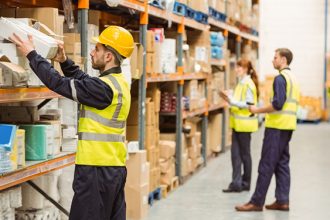
Further, when shift changes occur, bottlenecks form as multiple employees converge on the same pallet stacks. Each must wait their turn to retrieve what they need before production can begin. Every pallet retrieved manually often involves multiple touches from different workers, increasing labor inefficiencies. Two-person lifts slow the process further and drive up labor consumption.
“Floor space is another overlooked casualty,” added Costello. “Pallet stacks of 10 to 16 units consume hundreds of square feet near docks, aisle ends, and pick paths. That space becomes dead real estate—unavailable for staging, putaway, replenishment, or outbound flow.”
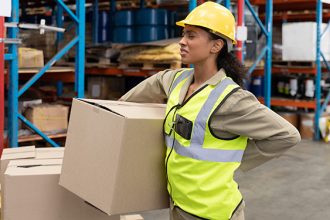
Perhaps the most serious impact, however, is the safety risk. Manual pallet handling exposes workers to ergonomic issues and musculoskeletal disorders. These include shoulder strains, lower-back injuries, and repetitive lifting stresses that can total tens of thousands of dollars per incident.
Frequent workers’ compensation claims raise what Costello called a facility’s experience modification rate (EMR). “EMR directly increases insurance premiums,” he explained. “Even a single claim can push a facility’s EMR from average to elevated, adding significant annual costs.”
Automated Pallet Dispensers Transform Workflows
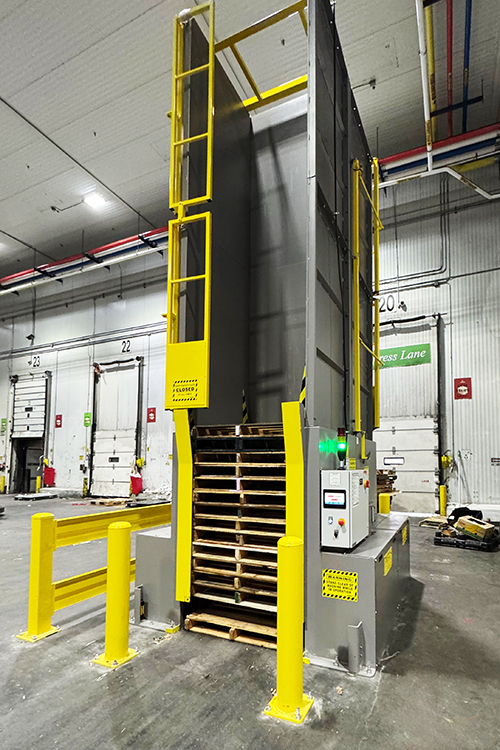
Automated pallet dispensers transform the entire process of supplying pallets to order pickers and forklift drivers. Instead of pulling pallets manually or retrieving them by forklift, operators receive one or more pallets at ground level at a consistent location. By reducing manual effort, the process becomes more ergonomic. The automation also eliminates the travel, floorspace, and congestion challenges associated with manual pallet retrieval, said Costello.
“Installing an automated pallet dispenser allows facilities to reclaim valuable floor space,” he explained. “That’s because large pallet stacks no longer occupy docks or aisle ends.”
Typical dispensers store up to 45 pallets in one machine, or up to 90 pallets in a double-deep machine. This eliminates the need for scattered storage locations.
“Workflows begin faster at shift start because operators no longer wait their turn at manual stacks,” Costello added. “Touches drop significantly, which reduces labor consumption. The dispensers also ensure that order pickers stay focused on productive tasks, not chasing pallets.”
The safety impact is equally transformative, he continued.
“Automated dispensing eliminates two-person lifts and removes the need to manually pull or tip pallets—two of the most common causes of back, shoulder, and wrist injuries,” said Costello. “Cleaner floors, the removal of broken pallet debris, and reduced forklift movement all contribute to safer working conditions and fewer recordable incidents.”
The overall result is a workflow that is faster, safer, cleaner, and far more predictable.
Calculating Automated Pallet Dispenser ROI
Calculating the return on investment (ROI) in automated pallet dispensers begins with establishing baseline metrics, advised Costello. He recommended quantifying:
- How long it currently takes to retrieve pallets.
- How many employees are required for manual pallet retrieval.
- The number of pallets retrieved per shift.
- The amount of floor space used.
“Based on those numbers, you can apply automated pallet dispenser performance assumptions. The difference reveals the financial impact,” he said.
Costello shared an example from a grocery distribution center (DC). By automating pallet dispensing, the facility eliminated 25 labor hours per day, reclaimed 300 square feet of dock space, and reduced the likelihood of a $42,000 back injury.
“Those savings compound fast. Especially when including the EMR impact in the calculation,” continued Costello. “In a facility where EMR dropped from 1.2 to 0.9, insurance premiums fell from $600,000 to $450,000, delivering a $150,000 annual benefit.”
Direct savings also add up quickly, he added.
“Eliminating manual pallet retrieval cut labor costs by roughly $62,500 per year. Reclaimed floor space added another $3,000 to $4,500 in value. Reduced product damage contributed $5,000 to $10,000 in annual savings,” Costello calculated. “Additionally, by avoiding even one major injury, the grocery DC stands to achieve more than $21,000 in direct savings. That doesn’t count even larger indirect costs that typically accompany claims.”
Depending on the cost of the equipment, payback generally falls under 11 months, he said. “When safety and EMR effects are included, many sites see payback in under six months.”
Get More Ergonomics Insights from the EASE Council
Looking for more solutions to improve ergonomics in your operations? Consult with the members of the Ergonomic Assist Systems & Equipment (EASE) Council. The association offers a variety of educational resources, presentations and seminars, technical papers, checklists, and ergonomic articles on their website.