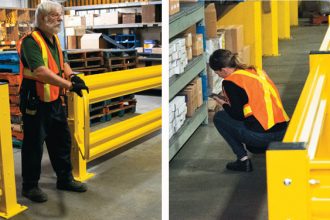

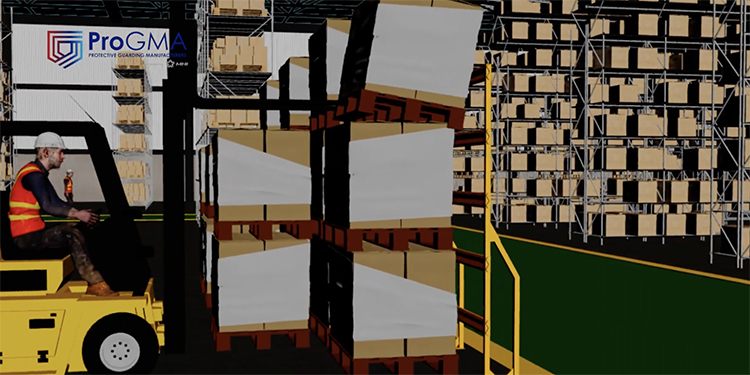
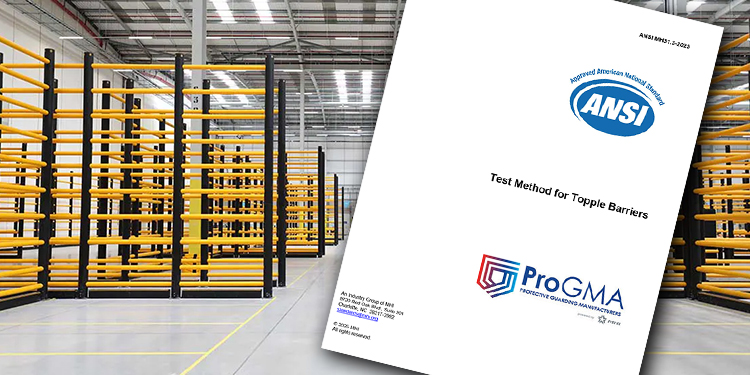
The Protective Guarding Manufacturers Association (ProGMA) has released a new video designed to simplify and explain the recently published ANSI MH31.3-2025 standard for topple barriers. The standard provides a detailed, technical framework for testing barrier performance. The video translates those requirements into clear, visual demonstrations that are easy to understand, regardless of engineering background. It also illustrates the processes used to evaluate these critical safety devices.
Why ProGMA Produced the MH31.3 Video
As warehouses continue to grow taller and floor-stacked storage becomes more common, the risk of falling or shifting loads increases. Topple barriers play a critical role in mitigating that risk. However, until now, evaluating their performance has been anything but straightforward.
“A key challenge in the barrier world is that every manufacturer has historically defined performance differently,” explained Aaron Wiegel, Director of Engineering for Barriers at Rite-Hite, a ProGMA member company. Wiegel is also a member of ProGMA’s Engineering Committee, which authored the ANSI standard. “The ability to compare products has been difficult.”
That inconsistency is exactly what ANSI MH31.3 aims to solve. The standard establishes a uniform, repeatable testing methodology. By using it, manufacturers can evaluate topple barriers using the same criteria. This ultimately permits end users to make more informed decisions.
“We all share customers, and we want to give them information that is fair and honest,” Wiegel said. “The way to do that is to establish a methodology that everyone agrees to use.”
What the Topple Barrier Standard Video Covers
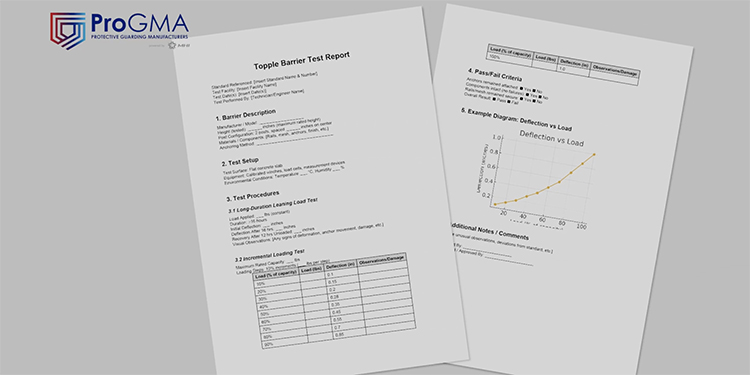
While the written standard outlines detailed testing procedures—such as incremental load applications and deflection measurements—the new ProGMA video brings those concepts to life.
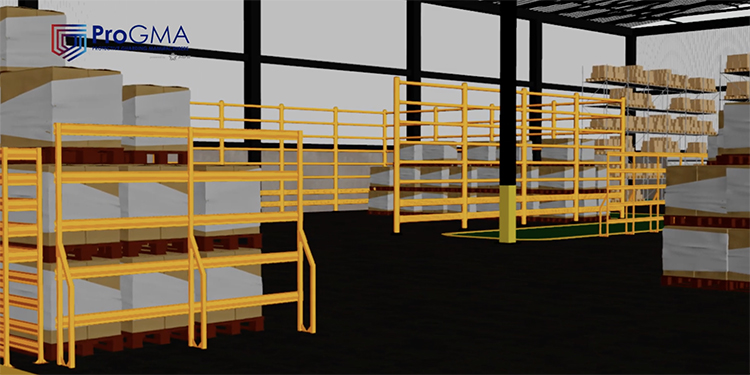
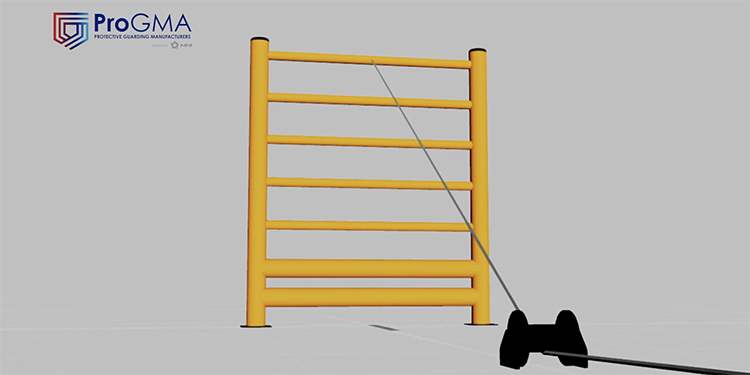
Through illustrated demonstrations, viewers can see how different types of topple barriers respond under load. The video illustrates key differences between rigid steel systems and flexible polymer designs. This enables users to better understand how each performs in various scenarios.
“The video does a great job of distilling the essentials,” Wiegel noted. “It shows what’s happening in a way that’s much clearer than reading through the standard.”
For example, one segment visually demonstrates the incremental loading process, with force applied in stages to measure how much a barrier deflects. Another highlights how barriers slow down falling loads. This important safety benefit may not always be obvious on paper, added Wiegel.
Understanding Topple Barrier Performance in Real-World Applications
Topple barrier performance is highly dependent on application. Factors like load weight, stacking height, product type, and distance from the barrier all influence outcomes.
“There are so many variables,” Wiegel explained. “Customers want to know, ‘Is this barrier strong enough for my application?’ Those are difficult questions to answer without consistent data.”
The ANSI MH31.3 standard—and the video that supports it—help bridge that gap by offering a baseline for comparison. Even though no test can perfectly replicate every real-world scenario, standardized results provide valuable guidance.
Helping End Users Choose the Right Topple Barrier Solution
One of the biggest advantages of ANSI MH31.3 is its ability to support better decision-making. By standardizing how manufacturers measure performance, the industry can move toward more transparent, data-driven comparisons.
Different applications may call for different types of barriers. Heavy, dense products may require rigid steel systems. Conversely, lighter or more stable loads could be suitable for flexible designs that absorb and dissipate energy.
“The video reinforces this idea by showing how various barrier types behave under stress,” Wiegel continued. “This helps viewers connect performance data to real-world use cases. Ultimately, the goal is not to prescribe a single solution, but to give users the information they need to choose the right one.”
A More Accessible Path to Safer Facilities
ANSI standards are inherently technical documents, often written for engineers and product developers. ProGMA’s video helps broaden that audience by making the concepts more accessible to safety managers, operations leaders, and facility decision-makers.
By pairing the rigor of ANSI MH31.3 with clear visual explanations, the video serves as a practical entry point for anyone looking to better understand topple barrier performance.
As Wiegel put it, “The standard gives us the framework, but the video shows it in action.”
For organizations evaluating protective guarding solutions, that combination of data and visualization can make all the difference.
See the Topple Barrier Standard in Action
ProGMA’s video also connects MH31.3 to its other ANSI standards. These include MH31.1 for steel mesh containment panels and MH31.2 for guardrails and barriers. Together, these standards ensure consistent testing for key protective guarding products. This gives users confidence that their safety equipment will perform reliably.
“Ultimately, the video makes a technical standard approachable,” noted Wiegel. “Plus, it demonstrates why MH31.3 matters for both manufacturers and end users. It’s an essential resource for anyone responsible for safety in warehouses or material handling environments.”
To watch the video and learn more about ProGMA and its members, visit mhi.org/progma.