
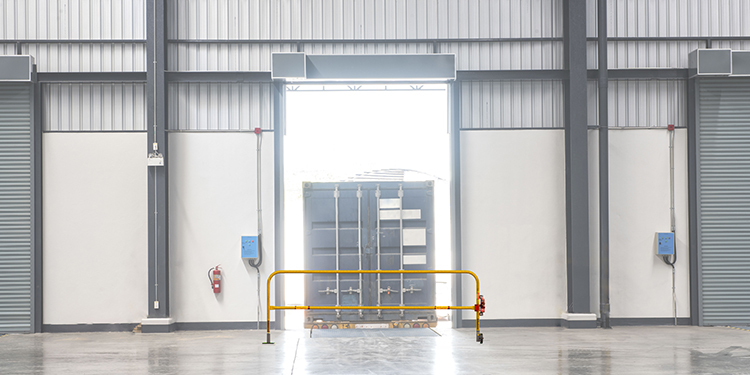
Daily, the loading dock tests a facility’s safety plan. Forklifts and pallet jacks move constantly between the warehouse floor and the trailers backed up outside. Employees walking through to check in shipments, work with paperwork, or get from one side of the building to the other. Add elevated pit edges, open dock doors, and pallet flow lanes into the mix, and you have one of the highest-risk areas in any facility. An injury on the shipping or receiving dock affects morale, productivity, and the bottom line. That’s why it’s essential to conduct a proper dock safety risk assessment.
“A loading dock is one of the busiest, most dynamic areas in any facility,” noted Amy Dinkel, Senior Marketing Specialist with Garlock Safety Systems. The company is a member of the Protective Guarding Manufacturers Association (ProGMA).
“You’ve got forklifts moving at speed, pedestrians crossing through, elevation changes, and open edges, sometimes all within a few feet of each other,” she continued. “That combination is exactly why a dock safety risk assessment should happen before the facility layout is finalized, not after an incident.”
Start With Pedestrian and Forklift Separation
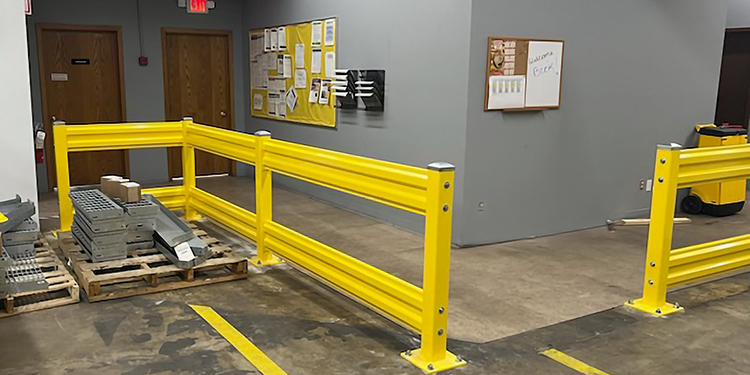
Any area where pedestrians and powered industrial trucks share space must comply with the Occupational Safety and Health Administration’s (OSHA) regulation 1910.176(a), which requires sufficient safe clearance around mechanical equipment. A risk assessment of your dock area should map out where forklifts travel, where they turn, and where blind corners or high-traffic crossings exist. It should then identify where to place a physical barrier that separates people from moving equipment.
Guardrail rated to absorb forklift impact is one of the most effective ways to create that separation. Incorporating swing gates into a guardrail system allows convenient, controlled access to offices, electrical panels, or other enclosed areas without compromising the barrier between pedestrians and forklift traffic.
“Pedestrian separation isn’t just about putting up a rail and calling it done,” Dinkel said. “It’s also about assessing the actual traffic patterns in your facility. That includes first determining where forklifts accelerate, which areas have limited visibility, and where people naturally want to cut through. Then design the barrier around that reality.”
Address Fall Hazards at Elevated Edges
Shipping pits, dock edges, and other elevated working surfaces present a serious fall risk. Under OSHA 1926.502(b)(3) and (b)(4), as well as 1910.29(b)(3) and (b)(4), any walking or working surface that is 4 feet or more below an upper surface requires fall protection at the edge. Permanent guardrail installed along shipping pits, elevated walkways, mezzanines, or other machinery hazard areas — indoors or outdoors — keeps those edges from becoming a liability.
“Fall protection at the dock often gets overlooked because people focus on the forklift traffic, not the edge itself,” Dinkel said. “A proper dock safety risk assessment looks at both. You need to ask where the drop-offs are, how far down do they go, and is there a permanent barrier in place, or are we relying on paint lines and hoping for the best?”
Control Access Points With Compliant Gates
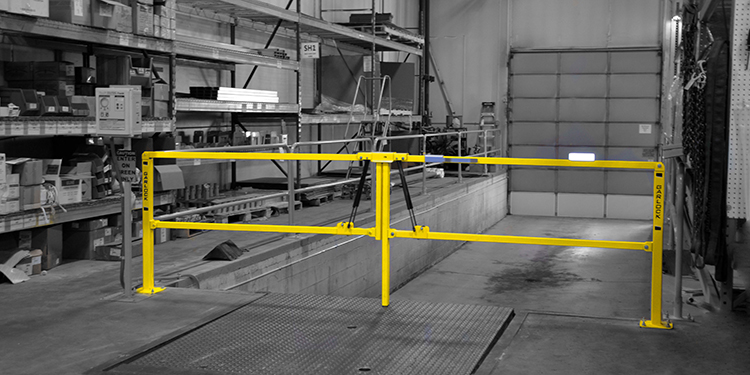
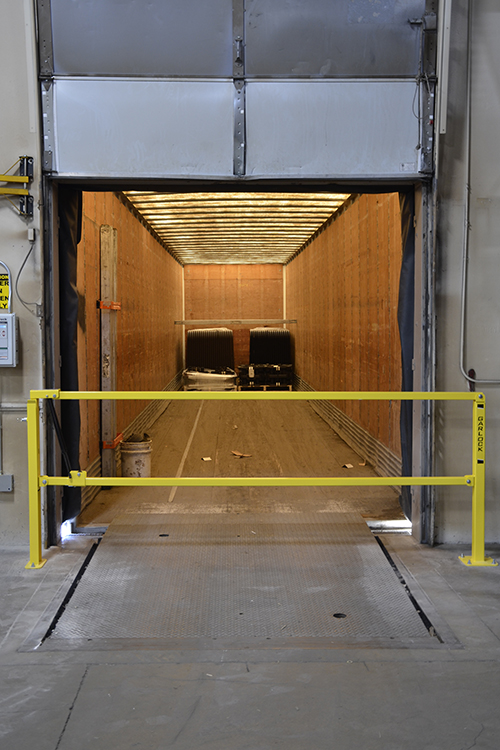 Loading and unloading naturally requires openings in an otherwise protected edge. Further, those openings need to be just as compliant as the rail surrounding them. Access gates at shipping pits and loading docks must meet the requirements of OSHA 1926.502(b)(3), (b)(4), and 1910.23(a)(2) to keep workers protected during the moments when the barrier is, by necessity, open.
“The gate is often the weakest link in an otherwise well-designed dock safety plan,” observed Dinkel. “It’s the one point where the barrier has to open. Therefore, it needs to be engineered just as carefully as the rest of the guarding. That is, something that closes reliably and that employees don’t prop open out of convenience.”
Make Your Dock Safety Risk Assessment an Ongoing Process
Ultimately, a dock safety risk assessment isn’t a single event that happens once before ribbon cutting. It should take place before facility construction begins, again as the space is built out, and periodically after the facility is operational and traffic patterns become clear.
Facility owners and managers should know what hazards to look for and understand how people and equipment actually move through the building. Then, select the right guarding solutions to mitigate those risks. Making this an ongoing, repeated process is what keeps a dock — and the people working on it — safe over the long term.
“Facilities change. Traffic patterns change. Products change. New equipment comes in, processes shift, and the risks shift with them,” added Dinkel. “The best dock safety programs treat risk assessment as something you revisit, not a box you check once and forget about.”
Find Protective Guarding Solutions for Your Dock
Looking for equipment to improve the safety of the people and assets on your shipping and receiving docks? The members of ProGMA offer the Protective Guarding Search Tool, a list of frequently asked questions (FAQs), case studies, and more. Visit ProGMA’s website at mhi.org/progma.