
EASE Council’s MODEX 2026 Panel Discusses the Importance of Ergonomics in the Age of Automation
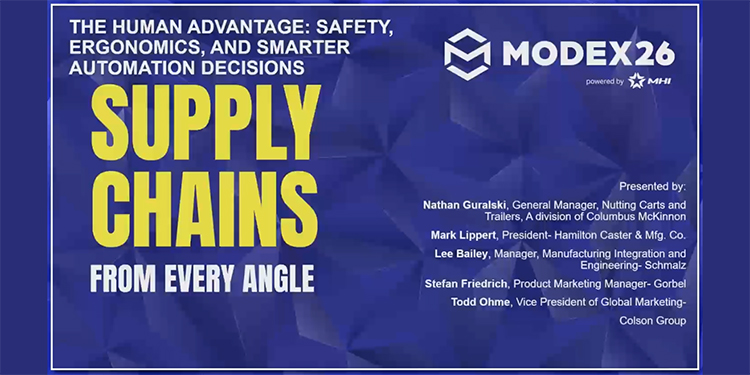
At MODEX 2026, the Ergonomic Assist Systems & Equipment (EASE) Council delivered an on-floor education session titled “The Human Advantage: Safety, Ergonomics, and Smarter Automation Decisions.” The session emphasized that even as adoption of automation accelerates, people remain at the center of material handling operations.
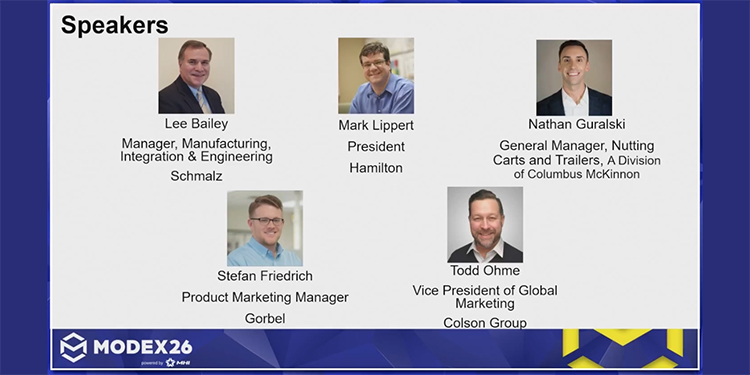
Moderated by EASE Council Vice Chair Nate Guralski, General Manager of Nutting Carts and Trailers, a Columbus McKinnon company, the panel featured:
- Lee Bailey, Manager of Manufacturing Integration and Engineering, Schmalz Inc.
- Stefan Friedrich, Product Marketing Manager, Gorbel.
- Mark Lippert, President, Hamilton Caster & Manufacturing Company.
- Todd Ohme, Vice President of Global Marketing, Colson Group.
Together, the panelists shared practical strategies for aligning ergonomics, safety, and automation to improve both performance and workforce well-being. A recording of the presentation is also available for viewing via the MODEX 2026 website.
Designing Ergonomics Into the Process from the Start
One of the panel’s first themes was the importance of integrating ergonomics early in facility and equipment design.
“Obviously, it’s cheapest up front to consider ergonomics while you’re designing,” said Ohme. “It becomes very expensive after installation.”
He pointed to a growing challenge across the industry: heavier loads combined with an aging workforce. These factors increase the risk of musculoskeletal injuries, especially in push-pull applications. Ohme advised retrofitting existing equipment, such as upgrading wheels and casters. Doing so is a practical first step for improving ergonomics without major capital investment.
This proactive approach aligns with guidance from the EASE Council’s recently released publication, “Industrial Ergonomics 101: An Introduction to Ergonomics in Industrial and Supply Chain Environments.” The resource emphasizes that prioritizing ergonomic design reduces injury risk and long-term costs.
Balancing Automation with Human-Centered Design
While automation continues to advance, panelists stressed that it must complement—not replace—human capabilities.
Friedrich advised companies to break processes into smaller steps when evaluating automation opportunities. “Start with the lowest hanging fruit,” he said. “Apply automation where there’s low variability, and use ergonomic equipment for high-risk, heavy tasks.”
This incremental strategy allows operations to improve safety and efficiency without overcommitting to complex systems too quickly.
Lippert added that hybrid approaches can also help manage costs. By combining powered solutions with non-powered carts and trailers, companies can move heavy loads efficiently while avoiding the “sticker shock” often associated with full automation.
Common Mistakes in Ergonomic Implementations
The panel highlighted several common pitfalls when introducing ergonomic and automation solutions. Chief among them? Failing to involve front-line workers.
“If you don’t include the operators, the system often doesn’t get used,” said Bailey. “That’s a total waste of money.”
Lippert reinforced this point, emphasizing education and engagement. “The best ideas come from the operators,” he said. “But first, they need to understand what ergonomics is and how it benefits them.”
Another key challenge is quantifying the impact of ergonomic improvements, observed Friedrich. He noted that many organizations lack reliable baseline data. “If you don’t have good benchmark data, you have no way to measure ROI,” he explained.
Without accurate metrics, companies may underestimate inefficiencies or overestimate performance. Establishing clear baseline measurements enables more informed decisions and helps justify investments in both ergonomic equipment and automation.
Ergonomics Drives Safety, Productivity, and Retention
Throughout the session, the panelists emphasized that ergonomics delivers benefits beyond injury prevention. According to the EASE Council’s Industrial Ergonomics 101 resource, improved ergonomics leads to:
- Lower injury rates through reduced strain and better posture.
- Increased productivity as workers experience less fatigue.
- Higher worker satisfaction and morale.
- Significant cost savings from fewer injuries and less downtime.
Bailey echoed these points from a workforce perspective. “If you’re proactively improving ergonomics, workers see that the company cares,” he said. “That leads to better retention and longer careers.”
He also noted that ergonomic solutions allow employees to remain productive as they age, helping companies retain experienced talent.
Sustaining Improvements in Ergonomics Over Time
Improving worker ergonomics requires more than a one-time investment. The panel stressed the need for ongoing training, standardization, and reinforcement.
“Training is key,” said Friedrich. “But reinforcement after training is just as important.”
Lippert added that operations must embed ergonomic practices into standard work processes. Documenting procedures and ensuring consistent use helps maintain long-term benefits.
Additionally, panelists encouraged companies to think ahead when specifying equipment. Selecting scalable solutions and planning for future needs can extend the value of initial investments.
The Human Advantage in Modern Operations
A recurring theme throughout the discussion was that small ergonomics improvements can have a significant impact.
Ohme shared a simple example from the show floor about a worker pushing a noisy, inefficient cart. “Everyone was acclimated to it,” he said. “Fixing something like that can make a big difference—not just physically, but psychologically.”
These everyday issues highlight the broader opportunity. By addressing ergonomic challenges, companies can create safer, more efficient, and more engaging workplaces.
Looking Ahead
As automation technologies evolve, the EASE Council’s MODEX 2026 educational session emphasized that the most successful operations will be those that balance innovation with human-centered design.
By combining ergonomics, smart automation strategies, and worker engagement, organizations can unlock measurable gains in safety, productivity, and profitability.
For more insights, the EASE Council encourages industry professionals to explore its Industrial Ergonomics 101 resource and connect with member companies for guidance on implementing effective ergonomic solutions. Visit mhi.org/ease for more information.