
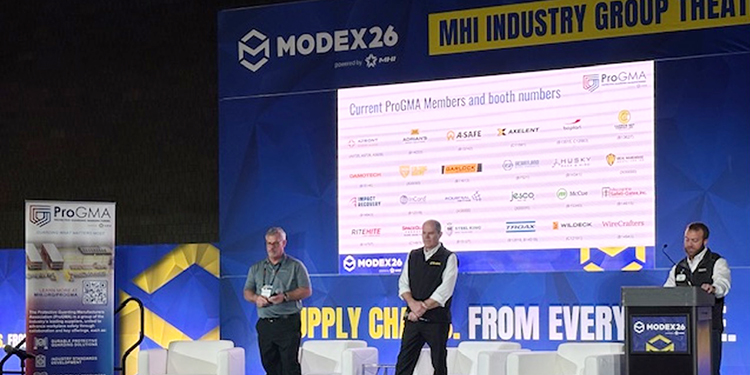
At MODEX 2026, members of the Protective Guarding Manufacturers Association (ProGMA) delivered an educational session titled “Verify with Confidence: Why Standardized Testing is Essential for Guarding Compliance and Safety Assurance.” The presentation focused on how American National Standards Institute (ANSI) standards bring consistency, transparency, and trust to protective guarding performance. The panel emphasized that standardized testing allows facilities to move beyond assumptions and specify solutions based on verified data.
Speakers included:
- Kyle Nobile, Senior Research and Innovation Engineer at 4Front Engineered Solutions and Chair of ProGMA.
- Ray Niemeyer, Vice President of Sales at SpaceGuard Products, Inc.
- Dave Dalleske, Senior Vice President of Sales, A-SAFE Inc.
Standardized ANSI Testing Eliminates Uncertainty
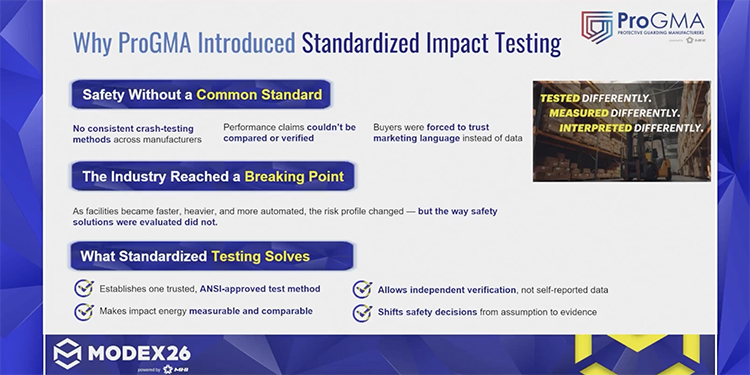
Nobile opened the session by addressing a long-standing challenge in the industry: inconsistent testing methods across manufacturers.
“For a long time, there was no consistent way to evaluate guarding products across manufacturers. That made it difficult for end users to truly verify performance claims,” he said.
Without standardized benchmarks, facilities often relied on supplier claims without a clear way to compare products. This lack of consistency created risk, particularly in environments where guarding must perform under real-world impact conditions.
To address this, ProGMA developed three ANSI standards that establish uniform testing methodologies. They include:
- ANSI MH31.1 – Steel Mesh Containment Panels Used in Pallet Rack and Vertical Storage System Applications: Performance and Testing Requirements.
- ANSI MH31.2 – Test Method for Crash Testing Industrial Guardrail Barriers and Barrier Posts.
- ANSI MH31.3 – Test Method for Topple Barriers.
Together, these standards provide a consistent framework for evaluating protective guarding systems across key applications.
Guarding To Catch Falling Objects: ANSI MH31.1
Niemeyer focused on ANSI MH31.1 and its role in preventing falling object hazards in rack systems. He explained that effective containment requires evaluating the entire system—not just individual components.
“It’s not just about the mesh—it’s about the entire system. The panel, the connections, and how everything performs together under impact,” Niemeyer said.
The standard uses pendulum impact testing to simulate real-world scenarios where items dislodge from racks. Testing includes strikes at both the center of the panel and near connection points, ensuring that mounting hardware performs alongside the mesh itself.
This comprehensive approach helps facilities confirm that containment systems will perform as expected, reducing the risk of injury and product loss.
Guarding Against Forklift Impacts: ANSI MH31.2
Dalleske highlighted ANSI MH31.2, which establishes a consistent method for evaluating guardrail performance under impact from mobile equipment.
“We’re measuring impact energy in a controlled way so end users can understand exactly how a system will perform when it’s hit,” he explained.
The standard measures impact energy in joules and uses controlled test conditions to simulate forklift collisions. It also evaluates impacts on both rails and posts, reflecting real-world scenarios where collisions rarely occur at ideal angles.
Accredited third-party laboratories conduct the testing. This results in objective data that facilities can use to compare products and make informed decisions.
Guarding To Contain Stacked Loads: ANSI MH31.3
Nobile also introduced ANSI MH31.3, which focuses on topple barriers designed to contain floor-stacked loads. These barriers are critical in preventing cascading failures when loads shift or collapse.
“It’s not just about stopping the initial event. It’s also about holding that load safely over time until it can be addressed,” Nobile said.
The standard includes sustained load testing to evaluate how barriers perform over time, as well as deflection testing to measure how systems respond under increasing pressure. This data helps facilities understand both immediate and long-term performance.
Why Verified Performance Matters
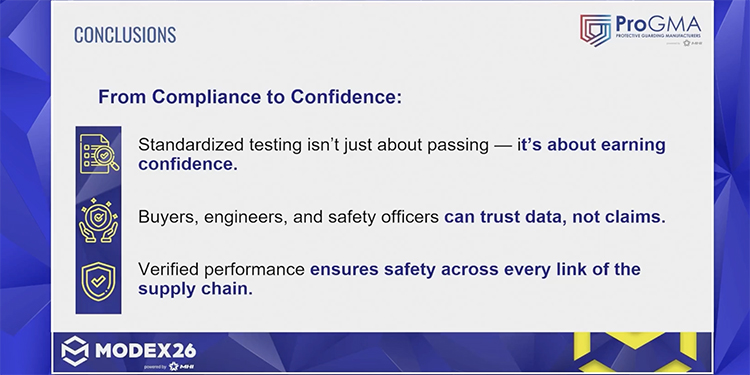
Throughout the session, the presenters emphasized that standardized testing delivers measurable value. It improves safety, reduces risk, and enables better decision-making.
By using ANSI standards, facilities can compare products using the same criteria, eliminating guesswork and ensuring that selected solutions meet real-world demands. Standardized testing also strengthens compliance efforts and builds confidence among stakeholders—from safety managers to executive leadership.
A key theme of the session was the shift from simply meeting requirements to specifying solutions based on proven performance. Facilities that adopt ANSI-tested guarding can reduce incidents, minimize downtime, and improve operational reliability.
ProGMA encourages companies to take a proactive approach:
- Request ANSI test data from suppliers.
- Specify guarding based on performance requirements.
- Compare solutions using standardized criteria.
- Prioritize long-term safety and reliability.
Learn More About ANSI Tested Guarding
The recording of this presentation is available on ProGMA’s YouTube channel. ProGMA members provide expertise, testing insight, and solutions designed to meet ANSI standards. By leveraging these resources, facilities can make informed decisions that protect people, products, and operations.
To learn more about ProGMA and its ANSI standards, visit mhi.org/progma.