
Industrial Traffic Warning Signals Improve Visibility and Prevent Collisions in Busy Facilities
In modern warehouses, manufacturing plants, and distribution centers, traffic warning signals play an increasingly important role in preventing collisions and improving situational awareness. These facilities’ operating environments include forklifts moving product through aisles, employees walking between work areas, and equipment running in tight spaces. While this constant activity keeps operations productive, it also creates safety risks. This is especially true for areas with limited visibility.
According to Sam Tromblay, a Business Development Manager at Rite-Hite—a member of the Protective Guarding Manufacturers Association (ProGMA)—industrial traffic warning signals help reduce these risks.
“Traffic warning systems improve visibility and communication between pedestrians and material handling equipment,” he explained. “The systems provide clear visual cues when traffic is approaching. This helps workers make safer decisions before entering potentially hazardous areas.”

Why Industrial Traffic Warning Signals Matter
Industrial environments often include blind corners, aisle intersections, and high pallet racks that block sightlines. When pedestrians and forklifts share the same space, even a brief moment of uncertainty can lead to collisions or near misses, noted Tromblay.
Traffic warning systems address this challenge by using sensors and visual alerts to communicate when people or vehicles are approaching from another direction.
“These solutions help improve awareness and prevent accidents in areas where traditional signage or floor markings may not be enough,” he continued. “With a sensor-driven guarding system that provides real-time warnings, facilities can maintain efficient workflows while reducing the likelihood of equipment damage or injuries.”
Additionally, industrial facilities tend be loud environments where audible alarms may go unnoticed. Visual warning systems provide a clear alternative by communicating hazards through bright, recognizable signals, added Tromblay.
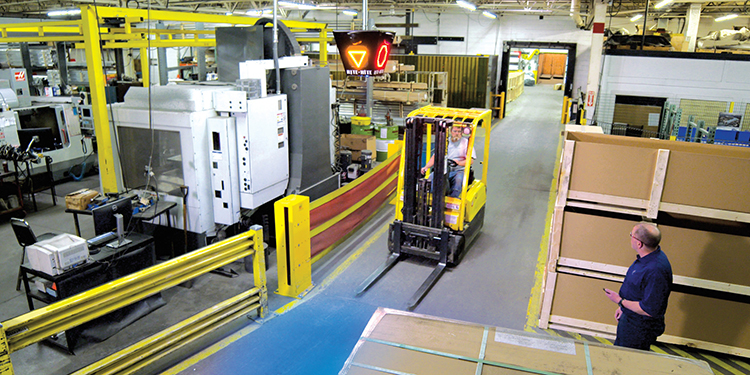
LED stop and yield indicators mimic familiar traffic symbols, allowing workers to interpret warnings quickly—even in fast-moving environments. Floor-projected lights and directional indicators further reinforce these warnings, making them visible from multiple angles.
Because these signals activate automatically upon detection of traffic, they help remove guesswork and ensure consistent communication throughout the facility.

Improving Visibility at Blind Corners and Intersections
Blind intersections are one of the most common locations for forklift-related collisions. Operators approaching from different directions may not see each other until it is too late to react.
By providing clear communication at intersections, traffic warning systems help prevent collisions before they occur, Tromblay said.
“Solutions such as ceiling-mounted intersection warning systems address this challenge by detecting traffic from multiple directions and displaying highly visible LED signals,” he explained. “Using sensors, the system detects approaching pedestrians or forklifts. It then communicates warnings by displaying illuminated symbols such as red stop signs and amber yield indicators.”
When multiple vehicles approach an intersection at the same time, the system can display stop signals and project a bright blue light onto the floor. This highly visible signal warns all parties that traffic is converging. That enables workers to quickly understand whether it is safe to proceed or whether they should yield or stop.

Enhancing Safety at Aisle Ends and Pedestrian Crossings
 Another common hazard area in warehouses is at the ends of rack aisles. Pedestrians exiting an aisle may step directly into the path of a forklift traveling down the main aisle.
There are traffic warning signals specifically designed for these environments, noted Tromblay.
“Facilities can deploy rack-mounted systems equipped with motion sensors to detect approaching traffic. Upon sensing a hazard, the device activates a flashing red LED chevron that indicates the direction of the approaching vehicle,” he said.
Because the warning light activates only when motion is detected, it captures attention without creating unnecessary visual distractions. Adjustable detection zones allow facilities to customize the system for specific aisle layouts or traffic patterns.
“In addition to rack mount options, the devices can also be affixed to walls,” Tromblay continued. “They’re extremely compact, allowing them to make a significant safety upgrade without taking up valuable floor space.”
Supporting a Layered Safety Strategy
Industrial traffic warning signals are most effective when used as part of a broader facility safety strategy. Visual alerts complement other safety measures such as protective guardrails, bollards, designated pedestrian walkways, and traffic management policies.
Together, these elements create a layered approach to safety—one that addresses both visibility and physical protection. While guarding systems protect structures and pedestrians from impacts, traffic warning signals help prevent those impacts from occurring in the first place.
This proactive approach supports both safety and operational efficiency.
How to Pick the Right Locations for Traffic Warning Systems
 Facilities considering traffic warning signals should start by identifying areas where visibility is limited or traffic patterns overlap. Common locations include:
- Blind intersections between aisles.
- Ends of rack rows where pedestrians enter main aisles.
- Doorways or openings between work areas.
- Crosswalks where pedestrian and forklift traffic intersect.
- Areas with obstructed sightlines caused by racking or equipment.
Conducting a facility walk-through or reviewing incident reports can help pinpoint locations where additional visual communication may be beneficial. ProGMA members are also available to help with such assessments.
Ultimately, industrial traffic warning systems provide a simple but powerful way to reduce collision risks in busy facilities, Tromblay concluded. “By alerting workers to approaching traffic and improving visibility at critical points, these systems help prevent accidents before they happen.”
Discover More Protective Guarding Resources
Seeking for more ways to safeguard the people and assets in your facility? The members of ProGMA publish a variety of safety solution resources and information. These include a Protective Guarding Search Tool, a list of frequently asked questions (FAQs), case studies, and more. Visit ProGMA’s website at mhi.org/progma.